
A Fellow’s Reflections
by Gannon Hyland, Fellow Alumnus ’25

When my wife and I first heard rumblings of the nascent Boethius Institute, both of us were very intrigued. An opportunity to join an intentional community dedicated to the study of the liberal arts proved too much to resist, and we eagerly applied for and were accepted to the first cohort of associate fellows. Modern technology (a la Zoom) provided our version of the Forum, and we met weekly, working our way through each of the seven arts. Both my wife and I held a few jobs at the time, so work demands were high, but it was a gift to come home and continue the conversation on what Aristotle may have been up to in his Organon. In fact, much of our early marriage was informed by these conversations, and for that we will always be grateful, for as we have come to understand, the liberal arts, rightly understood, are not merely intellectual disciplines but practices of formation within a living community ordered towards truth. This we hope to practice in the context of our own family. We’ve since welcomed two children and moved on to further projects, but what remains is a consistent thirst for truth and an expansion of the mind. Participating in the Boethius Institute as associate fellows helped both fuel and furnish this desire.
I received the great grace of being introduced to Boethius (the man) at Hillsdale College and then had the great privilege of teaching Boethius to students at Sacred Heart Academy. He has been a consistent figure in my intellectual journey, and I have been grateful for his companionship. C.S. Lewis’ Prof. Digory Kirk once proclaimed, somewhat exasperatedly, “It’s all in Plato, all in Plato: bless me, what do they teach them at these schools!” I am rather tempted to borrow the line and assert just as boldly, “It’s all in Boethius!” Of course, Boethius hails from the Platonic tradition, so there’s likely not too much of a contention in these parallel claims. Be that as it may, I do believe that Boethius exists as a treasure trove for the spirit. I have in mind his The Consolation of Philosophy, that great work of disorder, grief, and restoration.
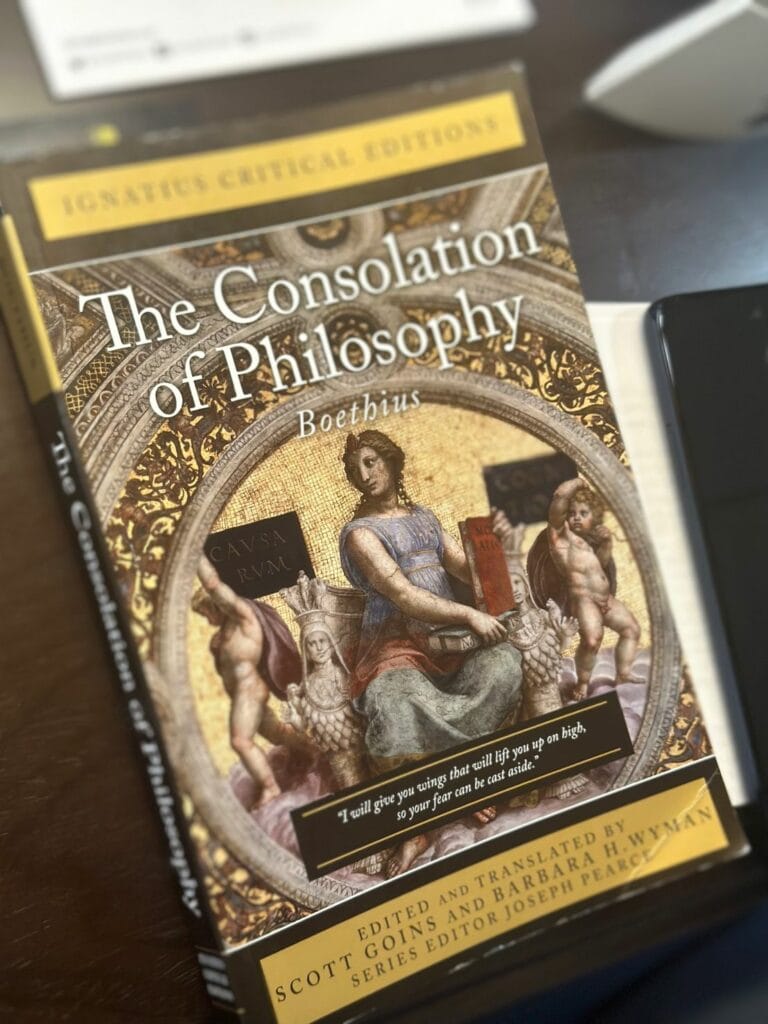
Boethius the writer introduces readers to Boethius the character’s plight in the first grief-stricken metrum. This elongated “woe is me” charts Boethius’ loss of joy and his resignation to the evils of man’s existence. In truth, the historical Boethius’ fall was great, and his cause for sorrow certainly was justified. But the revolution of Boethius’ interiority looked increasingly inward and downward and neglected the “love that moves the stars.” He had forgotten his true self and the true trajectory of man’s life. Some readers will be very familiar with this opening, and I don’t mean to belabor the point. But what strikes me in this moment is that Boethius, when he composes these verses, is “Silent and alone.” His music is not true music—certainly not the heavenly music of the celestial spheres—and he is alone, or believes himself to be alone. Is this typical for man? That left to his own devices and isolated from community that he spirals into a prison of the self? Perhaps so. At this pivotal moment, Lady Philosophy appears to Boethius the character, “holy” in look and “her eyes showed fire and pierced with a more-than-human penetration.” A more-fit-helper arrives to wipe his eyes and begin the laborious process of restoring Boethius to himself. The dialogue that ensues is a dialogue of community, of men and women speaking on the highest things.
The pattern is a familiar one. For the sake of an illustration, consider St. Monica and St. Augustine, sharing an intimate conversation in the port city of Ostia, being transported up and beyond themselves. What results is a communal articulation, wherein both St. Monica and St. Augustine express, “we stretch out and in a flash of thought / touch that eternal Wisdom who abides above all things…”
It’s a credit to the Boethius Institute to have recognized the great need that dialectical inquiry has for the heart of community. Man himself, as an integrated whole of intellect, affectivity, and volition, requires the engagement of all three. The hermit experiences this in a mystical way with the Trinity of Persons, separated in his asceticism but united in his prayer. Similarly, the lay faithful engage all faculties in the celebration of the Liturgy, but in addition to this, require human community as a buttress to the Liturgy. We see this in the great dialogues of the past, such as in Plato, Cicero, St. Augustine’s Cassiciacum dialogues, and we continue this tradition today. Something both mysterious and mystical unfolds as man wrestles with truth in an antiphonal manner. A teacher beckons, the student responds, and both tread wonderful paths. This is most fully realized in dialogue, and through such a dialogue, the ills of the world are not forgotten, but they receive new meaning and a proper orientation to the victory of the Cross.
An encounter with the liberal arts is not the final step of man’s restoration, but it is a great one. Perhaps it may be somewhat controversial to describe the liberal arts, things that are worthy for their own sake, as preeminently useful. Elevated, yes, but useful, for these liberal arts train and dispose the human mind for a proper engagement with the givenness and intelligibility of reality. This disposition touches all things: our thoughts, our words, and our actions. Hugh of St. Victor, one of the bright lights of the twelfth century, articulated man’s reformation as taking place in the heart of community. As he argues in the Didascalicon: when we read, imitate, contemplate, and practice the highest things, we become adorned with beauty.
Such a fellowship as that of the Boethius Institute is, I hope, the beginning of many such communities. This intentional conversation and way of life is perhaps the answer to much of our present fears, riddled as the world is with fear, brokenness, and isolation, ever increased by our own power and technological innovation. Boethius himself illumines the way forward: “And not in vain are hopes and prayers placed before God, since when they are just, they cannot be without effect. So let us shun vices and cultivate virtues, lifting our minds to proper hopes and offering human prayers on high. For, if you wish to speak the truth, a great necessity has been placed upon you men to do good, since you live in front of a judge who sees all things.” Formation in the liberal arts does not end in self-cultivation, a result St. John Henry Newman warns of in his university lectures; rather, this formation ultimately orients the human person toward a responsibility before truth itself.
Discover more from Boethius Institute
Subscribe to get the latest posts sent to your email.